
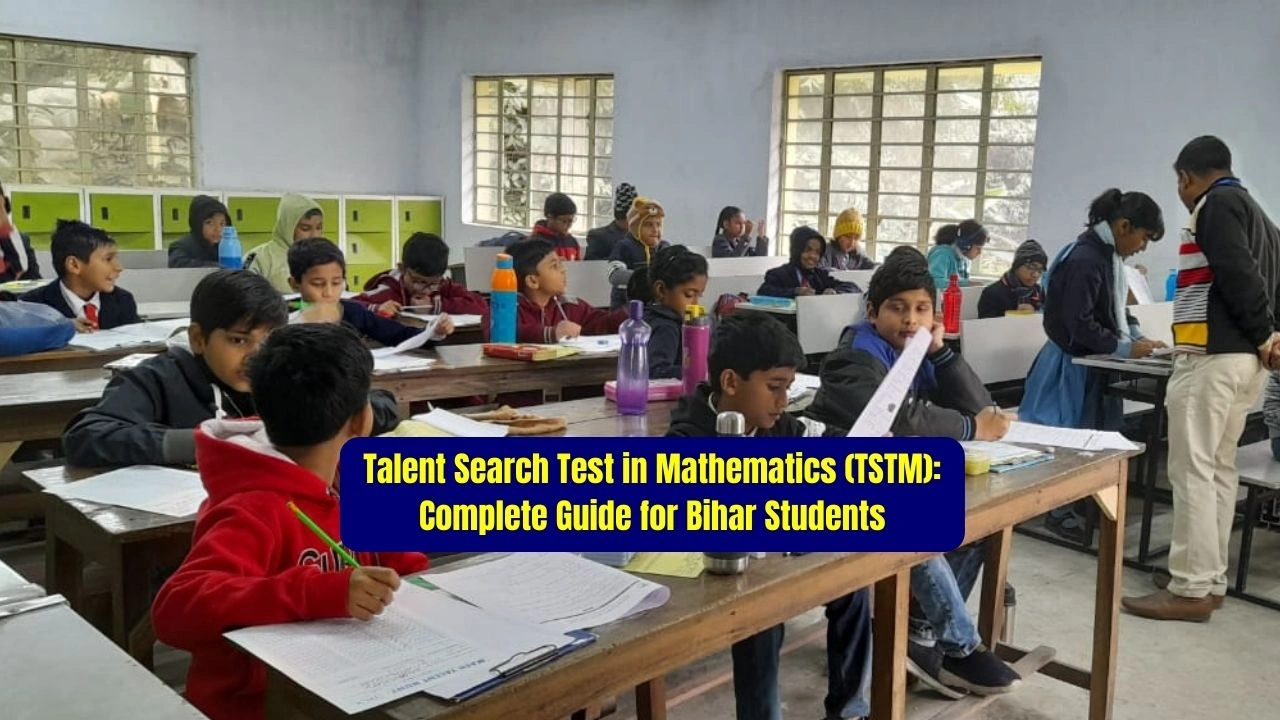
Mathematics has always been a subject that tests not just knowledge but the ability to think logically and solve complex problems. For students in Bihar who have a passion for mathematics, the Talent Search Test in Mathematics (TSTM) provides an excellent platform to assess their skills and gain recognition. The TSTM is designed to encourage students to go beyond their standard school curriculum and develop strong problem-solving abilities. Participating in this examination can enhance a student’s academic profile and open opportunities for future studies and scholarships in mathematics.
Talent Search Test in Mathematics (TSTM) for Bihar Students
The Talent Search Test in Mathematics (TSTM) is an annual competitive examination that evaluates students’ mathematical aptitude in a structured manner. For Bihar students, TSTM serves as a benchmark for measuring skills in logical reasoning, analytical thinking, and problem-solving. It is aimed at identifying students who excel in mathematics and providing them opportunities to participate in advanced learning programs. This exam not only tests conceptual knowledge but also the ability to apply mathematical principles creatively. Students who take part in TSTM develop stronger mathematical intuition, gain confidence in handling complex problems, and prepare themselves for other national-level competitions and higher academic pursuits.
1. What is TSTM?
The Talent Search Test in Mathematics is a specialized mathematics examination meant to identify and nurture young talent. Unlike regular school tests, TSTM challenges students with questions that require critical thinking, creativity, and speed. It encourages students to apply their knowledge to unfamiliar problems rather than relying solely on memorized solutions. TSTM provides a platform where students can measure their skills against peers, gain recognition at state and national levels, and build a strong foundation for higher studies in mathematics and related fields. The exam is widely regarded as a stepping stone for students aspiring to excel in mathematics competitions and academic research.
2. Eligibility Criteria
Before preparing for TSTM, students must ensure they meet the eligibility requirements. Eligibility criteria are structured to include a wide range of school students while maintaining a focus on academic standards.
Class or Grade
Students from Class 6 to Class 10 in Bihar are generally eligible to appear for the TSTM. Some institutions also provide separate categories for Class 11 and 12 students, but the primary focus remains on middle and high school levels.
School Type
All students enrolled in recognized schools in Bihar can participate. This includes government schools, private schools, CBSE and ISC-affiliated schools, and schools following the Bihar state board curriculum.
Registration
Registration is mandatory, either through the student’s school or via individual online application. Schools often facilitate bulk registration to ensure all eligible students can participate.
Age Limit
Most TSTM programs do not impose strict age limits as long as the student is enrolled in the appropriate grade.
Checking the official notification each year is essential to ensure compliance with updated rules or changes in eligibility.
3. Exam Pattern of TSTM
The exam pattern of TSTM is designed to evaluate speed, accuracy, and analytical ability rather than rote learning. Understanding the structure of the test is crucial for effective preparation.
Mode of Exam
Traditionally, the test is conducted as a pen-and-paper exam, but some versions may be available online through computer-based platforms.
Duration
Students are usually given between 90 minutes to two hours to complete the exam, depending on their class level.
Number of Questions and Types
The exam typically contains 40 to 50 questions, combining multiple-choice questions with problem-solving tasks. Questions are designed to test logical reasoning, conceptual understanding, and application skills.
Marking Scheme
Each question is generally assigned one to two marks, with negative marking applied in some cases for incorrect answers.
Sections Covered
The test usually includes sections such as Arithmetic, Algebra, Geometry, Number System, and Logical Reasoning. This ensures a comprehensive evaluation of a student’s mathematical skills.
4. Syllabus Overview
The TSTM syllabus is aligned with school curricula but emphasizes deeper problem-solving capabilities. Students must focus on both standard topics and areas that require critical thinking.
Class 6 Topics
- Number System
- Fractions and Decimals
- Basic Geometry
- Integers and Ratio
Class 7 Topics
- Rational Numbers
- Simple Equations
- Geometry and Mensuration
- Percentage and Data Handling
Class 8 Topics
- Linear Equations
- Squares, Cubes, and Roots
- Algebraic Expressions
- Exponents and Powers
Class 9 Topics
- Polynomials
- Coordinate Geometry
- Statistics and Probability
- Trigonometry
Class 10 Topics
- Real Numbers
- Quadratic Equations
- Arithmetic Progressions
- Trigonometry and Coordinate Geometry
TSTM questions often combine multiple topics in a single problem, testing the ability to apply concepts rather than memorize formulas.
5. Preparation Tips for Bihar Students
Effective preparation is essential for performing well in TSTM. Students should adopt a structured approach that balances conceptual understanding, problem-solving practice, and revision.
Understand the Syllabus
List all topics and subtopics according to your grade. This ensures no area is left unprepared.
Study from Textbooks First
NCERT and Bihar board textbooks form the backbone of preparation. Mastering these helps in building strong fundamentals.
Practice Previous Papers
Solving past years’ TSTM papers familiarizes students with question patterns and difficulty levels, improving both speed and accuracy.
Focus on Problem Solving
Practice logical reasoning puzzles and apply mathematical concepts to real-world problems. Shortcuts and mental calculation strategies can save valuable exam time.
Use Reference Material
Books like R.S. Aggarwal and M.L. Khanna offer challenging questions and advanced exercises that help strengthen conceptual clarity.
Take Mock Tests
Simulate exam conditions to manage time effectively and reduce anxiety during the actual test.
Regular Revision
Create formula sheets, revise weak topics frequently, and practice regularly to ensure retention.
Consistency
Steady daily practice is more effective than last-minute cramming.
6. Benefits of Appearing in TSTM
Participating in TSTM offers numerous advantages that extend beyond the exam itself.
Enhances Mathematical Thinking
Students develop stronger analytical and logical reasoning skills that improve overall mathematical ability.
Recognition and Awards
High performers receive certificates, medals, and scholarships, which help in academic growth and create a strong profile for higher studies.
Better Performance in Other Exams
Preparation for TSTM strengthens fundamentals, benefiting students in board exams and other competitive tests like NTSE and national mathematics olympiads.
Boosts Confidence
Success in the exam encourages students to take on more challenging problems and competitions, building self-confidence.
Opens Future Opportunities
A strong foundation in mathematics opens doors to careers in engineering, data science, economics, research, and academia.
7. Real-Life Tips for Bihar Students
To excel in TSTM, students should develop strategies that combine study efficiency with practical techniques.
Start Early
Long-term preparation ensures better retention and reduces stress.
Learn from Mistakes
Analyze incorrect answers carefully to avoid repeating errors.
Group Study
Collaborating with peers helps clarify doubts and exposes students to diverse problem-solving approaches.Maintain Health
A balanced diet, adequate sleep, and short breaks during study sessions are crucial for peak performance.
